
Living in Svalbard: Brave or Naive?
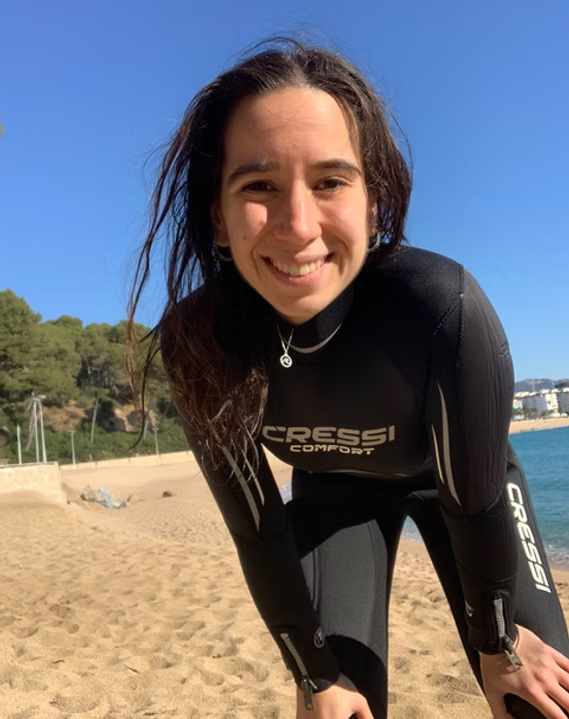
A personal story about moving to the northernmost settlement on Earth.
How does one decide to move to Svalbard?
While I had known for a while that polar research was my passion, I had never really thought about living in Svalbard. Honestly, I didn’t even know one could!
So how did I end up there?
Passion.
One day, my master’s supervisor sent me an email with a new PhD position: “Have you seen this?”
I started reading, and my eyes grew wider with every line. It was the perfect project: polar research, fieldwork, benthic ecosystems, and climate change—it ticked all my boxes. I started the application right away, even though the deadline was still months away.
After what felt like endless waiting (and a bit of self-doubt), I finally got the email: I had an interview! It went so well that I actually enjoyed it—though, of course, I had no idea if I’d get the job. They told me to expect a decision in three weeks. Two days later, I received another email: I was their top candidate.
I cried.
Most people were thrilled when I told them. Others said:
“It’s super cold and dark up there!”
“It’s very far away!”
“You’re not going to have more than two friends!”
“Do you realise how much you’re sacrificing?”
Did it make me insecure? Yes.
Did it stop me? Absolutely not.
This position was everything I had ever wanted. Before I knew it, I was packing my bags for the northernmost settlement on Earth. I was scared—but mostly excited. And from the moment I arrived, I felt it: a completely different sense of community. Everyone was welcoming, caring, and genuinely kind.

First Days: Into the Field
My first week in Svalbard, I went straight into the field. I was on cloud nine!
Out at sea, collecting samples, surrounded by glaciers and mountains—we even spotted dolphins and belugas. It was DREAMY. Photos by Riko Noormets (1), Carla López Mateo (2, 3).
Daily Life in the Arctic
When I finally settled into the office, I got to meet the rest of the department. That same warmth and openness I’d felt on arrival was everywhere.
Before moving, one of my biggest fears was boredom. I’m a very active person and love being involved in all kinds of activities. To my surprise, Longyearbyen is quite lively! There’s a running club on Tuesdays, quiz nights on Wednesdays, knitting on Thursdays, Friday gathering at the university, food festivals, mental health awareness events, running races, and upcoming festivals—and I’ve only been here three weeks!
Even grocery shopping is easier than I expected. As a vegetarian, I wasn’t sure what I’d find, but the supermarket is impressively well-stocked!
And of course—wool. Coming from the Mediterranean, I had never needed it before. Now I understand why everyone here swears by it. Also, everyone knits! Students even knit during lectures. It’s just part of the culture—practical and cozy.
Something else that’s very important here: protection.
Yes, we live in a settlement of about 2,500 people, but we share our home with wildlife—and that includes polar bears! Whenever you want to leave town, it’s mandatory to carry a rifle or go with someone who does. To learn how to handle a rifle safely, UNIS offers a free Polar Bear Safety course for students and staff, where you get to practice loading and firing at a target. The instructor was fantastic: calm, clear and focused on safety, which made my experience surprisingly comfortable. I wasn’t expecting to be as good as I turned out to be :’)
The Polar Bear Safety course. Photos by Carla López Mateo.
Waiting for the Polar Night
Something that still intimidates me a little is the Polar Night—months of complete darkness from November to February. In just three weeks, we’ve already lost about ten hours of sunlight.
People say the secret is keeping a routine: wake up early, go to work, do your hobbies, cook good meals, and take care of your body and mind. Some people find peace and beauty in the darkness; others prefer to take a break somewhere sunnier. I’m curious to see how I’ll handle it myself.
For now, I’m heading to Poland for a training course on meiofauna identification—the main focus of my PhD. When I return, it will already be completely dark outside.
I’ll keep you posted on how it goes!
Photos by Carla López Mateo.
A few thoughts before I go
Moving to Svalbard might seem brave—or naive—depending on how you look at it. But for me, it was the right choice. It’s not always easy, but it’s deeply fulfilling. If there’s one thing I’ve learned so far, it’s that passion can take you to the ends of the Earth (literally).
Written by Carla López Mateo Follow Carla’s research on Instagram!


Comments