
From the Arctic to Antarctica: the highs and lows of fieldwork
- Constance Lefebvre

- Apr 21
- 2 min read
On the 9th April, APECS members Lisa Ardoin and Coraline Leseurre gave joint talks at ULB about their experiences in the field in polar environments. The event was organized by WomInTech, a ULB student-led organization promoting gender diversity in engineering and other STEM fields.



Coraline and Lisa present their field campaigns at the WomInTech event at ULB. Event photo credit: Constance Lefebvre.
Lisa is a glaciologist finishing her PhD at ULB. She studies gases trapped in basal ice. In the winter (or Antarctic summer) of 2024-2025 she had the amazing opportunity to join the Beyond EPICA three-months drilling campaign at Little Dome C in Antarctica. With a close-knit team of scientists, engineers, and medical staff, she helped retrieve the oldest continuous paleoclimatic record: ice as old as 1 million years and as deep as 2.8 km, all the way down to the bedrock! But life at the drilling camp was not all breezy. The team had to contend with very negative temperatures, altitude sickness, long work shifts, and rather cramped living quarters. Despite it all, Lisa would go back in a heartbeat. Beyond the groundbreaking science and the beautiful pristine landscape, it was also an incredible human experience.
Coraline is a postdoctoral researcher at the Vlaams Instituut voor de Zee (VLIZ), where she studies greenhouse gas air-sea exchanges. During her studies and PhD, she participated in several sampling campaigns in both the Arctic and Southern Oceans. Her fieldwork took her to stunning, isolated islands where she got to see incredible landscapes and wildlife. But these once-in-a-lifetime experiences come with the occasional violent storm she valiantly weathered in her cabin with a bucket at hand! For Coraline though, the open ocean, the aurora australis, and the chances to further our understanding of sea-gas exchanges are well worth the bouts of seasickness.

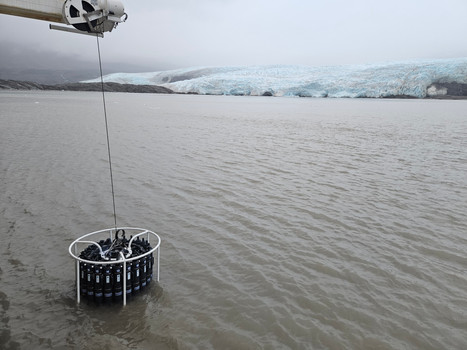


Greenhouse gases sampling in front of a marine-terminating glacier in the Storfjorden (Svalbard) in August 2024 on the RV Skagerak. Credit: Coraline Leseurre, Filip Stedt


The RV Marion Dufresne during a storm in the Southern Ocean, and looking out towards the Kerguelen Island and the king penguin, during the SWINGS cruise (Jan-Mar 2021). Credit: Coraline Leseurre & SWINGS team.
Being a field scientist is hard work and being a woman in isolated environments comes with its own set of challenges, but you should not let it hold you back. As Lisa put it: “More diverse field teams will only make everyone’s experience better!”

Seven women participated in the 2024-2025 Beyond EPICA campaign. Event photo credit: Constance Lefebvre.
If you want to know more about Lisa’s adventures in Antarctica, you can watch her vlogs on Instagram.
You can learn more about WomInTech and the work they do on their website.
Follow Lisa on social media: Instagram
Written by Constance Lefebvre


Comments